
How to Address Protection Risks for Solid Product Loads
In such a diverse industry as chemicals, agrochemicals, and solid products, there is often a need for a packaging solution that is versatile and can adapt to different load formats. However, the formula for protecting solid product loads is not that simple and must be adapted to the needs, format characteristics, and risks that the product may face. In a multisector such as the solid products industry, it is advisable to assess the risk points throughout the logistics chain and choose the packaging system that helps us improve protection and logistics efficiency.
Based on our more than 25 years of experience as packaging systems manufacturers, in this article we take an in-depth look at the most common risks in the solid products sector, regardless of format, and how to address them with specialized packaging systems and processes. We discuss risks related to moisture, external factors, instability, fragility, the risk of breakage or tearing, improper securing, etc., as well as our proposed solutions and the considerations that should be taken into account in each case.
Risk Factors for Solid Products
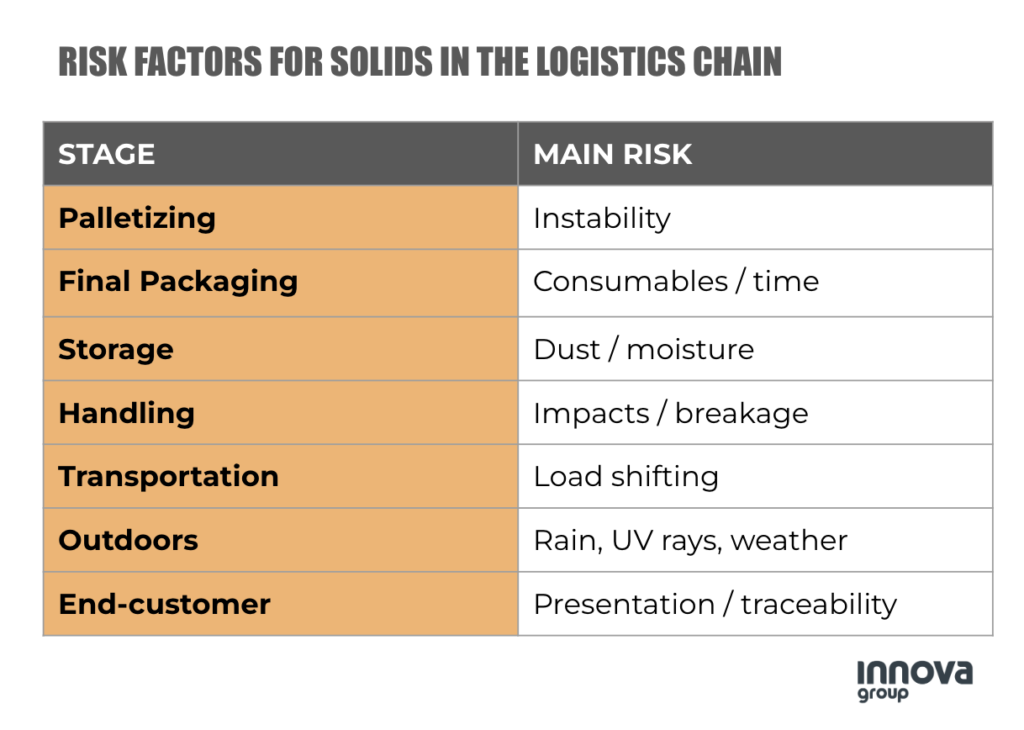
The best packaging system is one that protects the product throughout its entire logistics journey: Production → Packaging → Storage → Handling → Transportation → Final Storage → End Customer.
At each stage, different risks arise that can be addressed through different combinations and packaging processes.
Is the product sensitive to moisture?
In the chemical and solid products industries, this is often one of the most important risk factors, as it is not enough to simply secure the load and provide limited protection: moisture can damage the product and cause losses. Some clear examples include mortars and adhesives, powdered chemicals, pellets, fertilizers, substrates, animal feed, bulk food products, etc.
- RISK: Moisture
- SOLUTION: Fully cover the load with a Stretch Hood system.
- CONSIDERATIONS: It is important to consider whether the product also requires a securing system. If the format or palletizing does not provide sufficient stability on its own, it should be assessed whether an additional securing system, such as a stretch wrapper or strapping machine, is required, or whether the Stretch Hood film itself can provide the necessary securing.
For more information on Stretch Hood’s protection against moisture and water, we recommend:
Is the load unstable or does it have irregular shapes?
Although most loads come in relatively stable formats, there are certain unstable loads that require special securing. These include:
- Stacked big bag formats.
- Loads with different heights.
- Picking of bags or boxes.
- Drums.
- Lightweight loads, even when packed in bags.
- Very tall loads of bags or boxes.
At this point, we must assess the actual stability of the load rather than simply wrapping the pallet.
- RISK: Stability
- SOLUTION: Secure the load to its base using different packaging systems and/or combinations. Some options include:
- Unstable boxes: stretch wrapper with cord.
- Unstable boxes that require protection: stretch wrapper with cover or Stretch Hood.
- Tall boxes / tall drums: vertical or horizontal strapping.
- Double-stacked pallets, big bags, tall loads, etc.: Stretch Hood with special film. Thanks to the vertical and horizontal forces generated during hooding, it can provide additional securing.
- CONSIDERATIONS: In the case of particularly unstable loads, it is important to determine whether full protection is also required in order to assess the most appropriate combination of systems.
For more information on how to secure loads of various shapes, heights, and sizes, we recommend:
Does the product need to be stored outdoors?
In this case, the decision-making criterion is very clear. A pallet may have complete stability but still not be protected against external factors such as rain, ambient moisture, dust, and other weather conditions.
- RISK: External factors
- SOLUTION: Cover and protect the load with a Stretch Hood system.
- CONSIDERATIONS: In this case, we assume that the pallet already has sufficient stability, as may be the case with cement loads or big bags of chemical products. Even so, it is necessary to assess whether a stretch wrapper or strapping machine is needed to reinforce load securing.
Is there a risk of bags breaking during transportation?
Often, the risk or problem is not the stability of the load itself, but rather the secondary packaging, in this case the bag or cardboard box. The outer packaging system should help compact and protect the load, but pallet protection is only part of the solution: bag quality, palletizing, bag filling, etc., are also key factors.
As we know, a broken bag can result in product loss, contamination, claims, non-conforming product, or additional logistics costs.
- RISK: Secondary packaging breakage
- SOLUTION: In the case of bags, use optimal bag filling and palletizing for the load and Stretch Hood to compact and protect it.
- In the case of boxes, use a reinforced boxing process with strapping or a stretch wrapper, together with Stretch Hood to protect the load.
- CONSIDERATIONS: In this case, we are also assessing the secondary packaging process. We often assume that the problem comes from the final packaging system, but issues involving load shifting and breakage may actually originate at earlier stages.
Are there many different formats at the same plant?
Format is a requirement, but it can also become a risk in itself, as a very generic packaging system may be insufficient for all the formats, packages, and dimensions used in production. Adjustments and consumables that are perfect for one specific format may be too loose or may not completely cover another format.
This is particularly the case for companies with multi-format production that handle their solid products in bags, big bags, boxes, or drums within the same production line, or that work with different pallet dimensions, different heights, etc.
- RISK: Inefficiency or limited adaptability in multi-format production
- SOLUTION: The Stretch Hood system is one of the most versatile solutions, as it allows different formats and dimensions to be protected with a single machine. Stretch Hood film is a special stretch film that adapts to the shape of the load, unlike the conventional film used in a stretch wrapper.
In addition, most Stretch Hood models can work with different film sizes. At Innova, for example, it is possible to use up to 3 rolls of different sizes. There is also the possibility of adapting the system to different formats through XL hooding solutions, which allow both large loads and standard pallets to be hooded, as is the case with Innova’s Stretch Hood XL. - CONSIDERATIONS: It is important to review the requirements of each format and take into account the protection and stability criteria mentioned above. For example, a stretch wrapper may be a suitable alternative for multi-format production when full load protection is not the objective.
We recommend reading this success story featuring Colorobbia (a chemical manufacturer of frits and glazes), in which Innova’s Stretch Hood system protects its variety of different cargo types: sacks, big bags, boxes, and chemical drums.
Ultimately, it is important to assess the objectives of a packaging project while taking into account the underlying problem, which is usually related to product damage or losses. Why is the packaging system being updated or replaced? Having this objective clearly defined helps us determine what type of solution we need.
At Innova, our engineering team can recommend the system that best suits your product, format, and potential risks. Do not hesitate to contact us with no obligation.